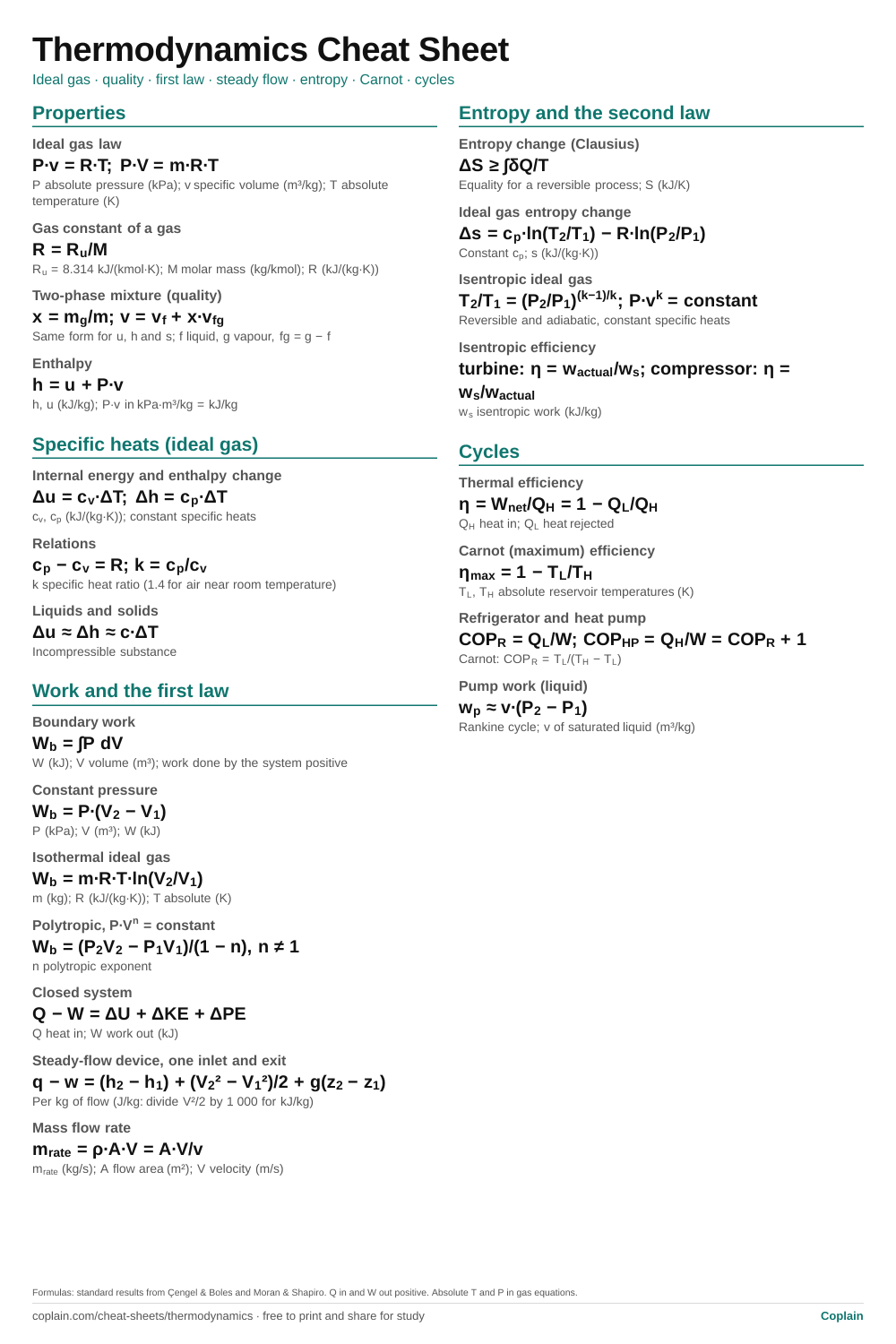
The equations of a first engineering thermodynamics course on one page: properties and the ideal gas law, two-phase mixtures, specific heats, boundary work, the first law for closed and steady-flow systems, entropy and the second law, and cycle efficiencies. Each line lists its variables and units.
Properties: formula, then every variable with its unit
Quantity
Formula
Variables and units
Ideal gas law
P·v = R·T; P·V = m·R·T
P absolute pressure (kPa); v specific volume (m³/kg); T absolute temperature (K)
Gas constant of a gas
R = Ru/M
Ru = 8.314 kJ/(kmol·K); M molar mass (kg/kmol); R (kJ/(kg·K))
Two-phase mixture (quality)
x = mg/m; v = vf + x·vfg
Same form for u, h and s; f liquid, g vapour, fg = g − f
Enthalpy
h = u + P·v
h, u (kJ/kg); P·v in kPa·m³/kg = kJ/kg
Specific heats (ideal gas)
Specific heats (ideal gas): formula, then every variable with its unit
Quantity
Formula
Variables and units
Internal energy and enthalpy change
Δu = cv·ΔT; Δh = cp·ΔT
cv, cp (kJ/(kg·K)); constant specific heats
Relations
cp − cv = R; k = cp/cv
k specific heat ratio (1.4 for air near room temperature)
Liquids and solids
Δu ≈ Δh ≈ c·ΔT
Incompressible substance
Work and the first law
Work and the first law: formula, then every variable with its unit
Quantity
Formula
Variables and units
Boundary work
Wb = ∫P dV
W (kJ); V volume (m³); work done by the system positive
Constant pressure
Wb = P·(V2 − V1)
P (kPa); V (m³); W (kJ)
Isothermal ideal gas
Wb = m·R·T·ln(V2/V1)
m (kg); R (kJ/(kg·K)); T absolute (K)
Polytropic, P·Vn = constant
Wb = (P2V2 − P1V1)/(1 − n), n ≠ 1
n polytropic exponent
Closed system
Q − W = ΔU + ΔKE + ΔPE
Q heat in; W work out (kJ)
Steady-flow device, one inlet and exit
q − w = (h2 − h1) + (V2² − V1²)/2 + g(z2 − z1)
Per kg of flow (J/kg: divide V²/2 by 1 000 for kJ/kg)
Mass flow rate
mrate = ρ·A·V = A·V/v
mrate (kg/s); A flow area (m²); V velocity (m/s)
Entropy and the second law
Entropy and the second law: formula, then every variable with its unit
Quantity
Formula
Variables and units
Entropy change (Clausius)
ΔS ≥ ∫δQ/T
Equality for a reversible process; S (kJ/K)
Ideal gas entropy change
Δs = cp·ln(T2/T1) − R·ln(P2/P1)
Constant cp; s (kJ/(kg·K))
Isentropic ideal gas
T2/T1 = (P2/P1)(k−1)/k; P·vk = constant
Reversible and adiabatic, constant specific heats
Isentropic efficiency
turbine: η = wactual/ws; compressor: η = ws/wactual
ws isentropic work (kJ/kg)
Cycles
Cycles: formula, then every variable with its unit
Quantity
Formula
Variables and units
Thermal efficiency
η = Wnet/QH = 1 − QL/QH
QH heat in; QL heat rejected
Carnot (maximum) efficiency
ηmax = 1 − TL/TH
TL, TH absolute reservoir temperatures (K)
Refrigerator and heat pump
COPR = QL/W; COPHP = QH/W = COPR + 1
Carnot: COPR = TL/(TH − TL)
Pump work (liquid)
wp ≈ v·(P2 − P1)
Rankine cycle; v of saturated liquid (m³/kg)
How to use this cheat sheet
Start every problem by naming the system (closed or control volume) and the process (constant P, constant T, isentropic, steady flow). That decides which line of the sheet applies.
Use absolute temperature (K or °R) and absolute pressure in every gas equation. Gauge pressure in P·V = m·R·T is the most common wrong answer.
For water and refrigerants, the ideal gas lines do not apply near saturation: look up properties in steam or refrigerant tables, then use the first-law and efficiency lines with those values.
Example: Ideal compressor outlet temperature and work
Given
Air enters a compressor at P₁ = 100 kPa, T₁ = 300 K
It leaves at P₂ = 800 kPa
Reversible and adiabatic (isentropic); steady flow; neglect kinetic and potential energy changes
Air as an ideal gas with constant c_p = 1.005 kJ/(kg·K) and k = 1.4 (typical values)
Find
The exit temperature T₂
The work input per kilogram of air
Solution
Isentropic relation for an ideal gas.T₂ = T₁·(P₂/P₁)^((k−1)/k) = 300 K × 8^0.2857
Evaluate the pressure ratio term.8^0.2857 = 1.811 → T₂ = 543.4 K
Steady-flow first law with q = 0 and no KE or PE change: the work input equals the enthalpy rise.w_in = h₂ − h₁ = c_p·(T₂ − T₁)
Answer: T₂ ≈ 543 K (270 °C); w_in ≈ 245 kJ/kg. A real compressor needs more work and runs hotter.
Printable cheat sheet
The PDF is one US Letter page that also prints on A4 without cropping. The 2:3 PNG is the same sheet as an image, sized for a phone lock screen or a pin. Both are made from the formulas in the tables above, so they always match.
Heat added to the system and work done by the system are positive: Q − W = ΔU. Some textbooks use W done on the system as positive; the physics is the same but the sign of W flips.
When can I treat a gas as ideal?
When the pressure is low compared with its critical pressure and the temperature is well above its critical temperature. Air at ordinary conditions qualifies; steam near saturation does not.
Why are constant specific heats an approximation?
c_p and c_v rise with temperature. Constant values from room temperature are close for moderate temperature changes; for large ones, use variable-specific-heat ideal-gas tables.