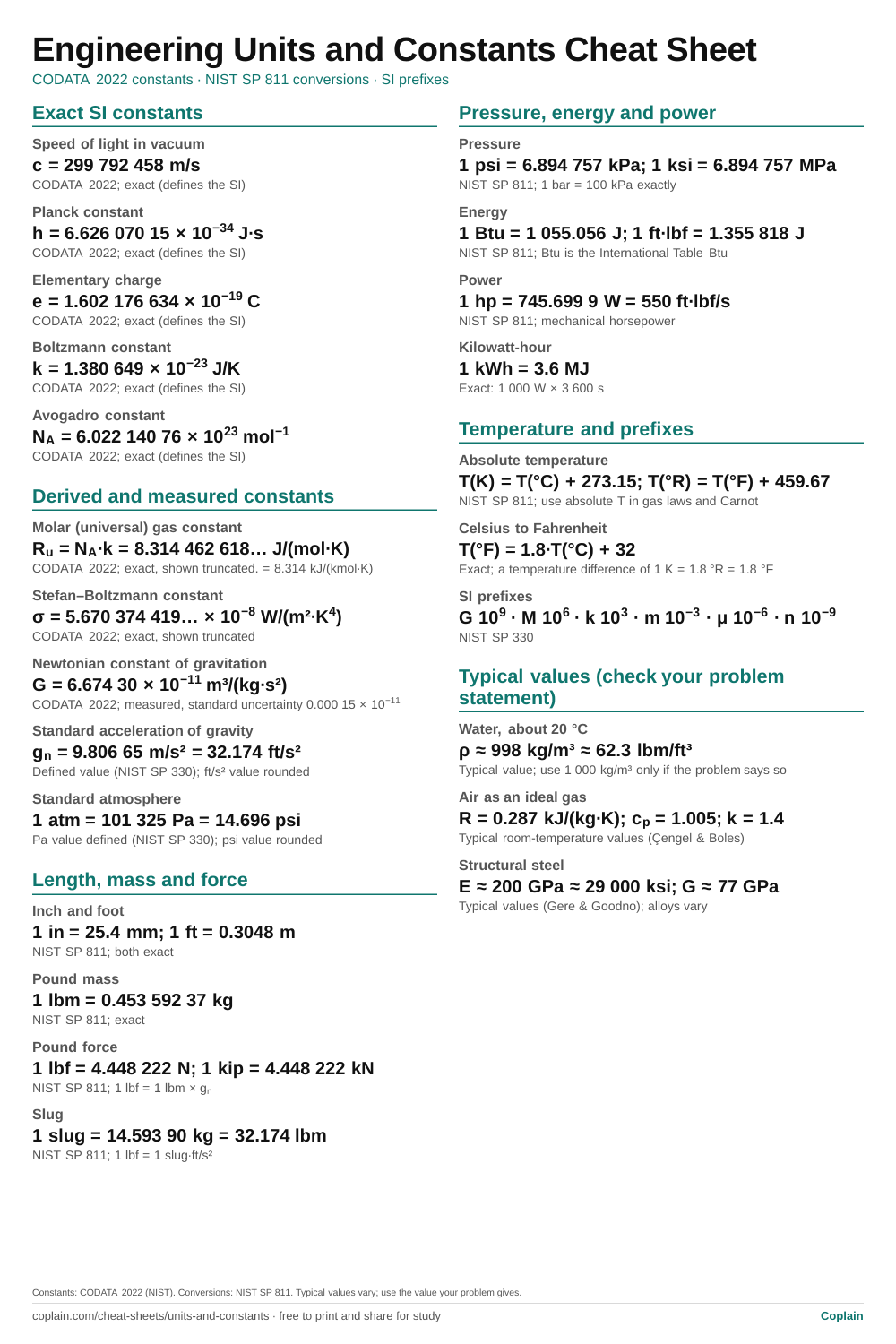
The constants and unit conversions an engineering student uses every week, on one page. Fundamental constants are the CODATA 2022 values published by NIST, conversion factors come from NIST Special Publication 811, and typical material values are labeled as typical.
CODATA 2022; measured, standard uncertainty 0.000 15 × 10−11
Standard acceleration of gravity
gn = 9.806 65 m/s² = 32.174 ft/s²
Defined value (NIST SP 330); ft/s² value rounded
Standard atmosphere
1 atm = 101 325 Pa = 14.696 psi
Pa value defined (NIST SP 330); psi value rounded
Length, mass and force
Length, mass and force: formula, then every variable with its unit
Quantity
Formula
Variables and units
Inch and foot
1 in = 25.4 mm; 1 ft = 0.3048 m
NIST SP 811; both exact
Pound mass
1 lbm = 0.453 592 37 kg
NIST SP 811; exact
Pound force
1 lbf = 4.448 222 N; 1 kip = 4.448 222 kN
NIST SP 811; 1 lbf = 1 lbm × gn
Slug
1 slug = 14.593 90 kg = 32.174 lbm
NIST SP 811; 1 lbf = 1 slug·ft/s²
Pressure, energy and power
Pressure, energy and power: formula, then every variable with its unit
Quantity
Formula
Variables and units
Pressure
1 psi = 6.894 757 kPa; 1 ksi = 6.894 757 MPa
NIST SP 811; 1 bar = 100 kPa exactly
Energy
1 Btu = 1 055.056 J; 1 ft·lbf = 1.355 818 J
NIST SP 811; Btu is the International Table Btu
Power
1 hp = 745.699 9 W = 550 ft·lbf/s
NIST SP 811; mechanical horsepower
Kilowatt-hour
1 kWh = 3.6 MJ
Exact: 1 000 W × 3 600 s
Temperature and prefixes
Temperature and prefixes: formula, then every variable with its unit
Quantity
Formula
Variables and units
Absolute temperature
T(K) = T(°C) + 273.15; T(°R) = T(°F) + 459.67
NIST SP 811; use absolute T in gas laws and Carnot
Celsius to Fahrenheit
T(°F) = 1.8·T(°C) + 32
Exact; a temperature difference of 1 K = 1.8 °R = 1.8 °F
SI prefixes
G 109 · M 106 · k 103 · m 10−3 · μ 10−6 · n 10−9
NIST SP 330
Typical values (check your problem statement)
Typical values (check your problem statement): formula, then every variable with its unit
Quantity
Formula
Variables and units
Water, about 20 °C
ρ ≈ 998 kg/m³ ≈ 62.3 lbm/ft³
Typical value; use 1 000 kg/m³ only if the problem says so
Air as an ideal gas
R = 0.287 kJ/(kg·K); cp = 1.005; k = 1.4
Typical room-temperature values (Çengel & Boles)
Structural steel
E ≈ 200 GPa ≈ 29 000 ksi; G ≈ 77 GPa
Typical values (Gere & Goodno); alloys vary
How to use this cheat sheet
Carry units through every line of a calculation and cancel them like algebra. If the units of the answer come out wrong, the setup is wrong, and that check costs nothing.
Convert to one consistent system before you start: SI (N, m, kg, s, Pa) or US customary with slugs or lbm handled explicitly. Most lost points on US-unit problems come from mixing lbm and lbf without dividing by g_c = 32.174 lbm·ft/(lbf·s²).
Values marked exact are exact by definition, so they never limit precision. The typical material values vary with temperature and alloy; use the value your problem gives whenever it gives one.
Example: Hydraulic cylinder force in SI and US units
Given
Cylinder bore d = 2.50 in
Oil pressure p = 1 500 psi (gauge)
Ignore friction and rod-side pressure
Find
The push force F in lbf and in kN, worked both ways as a check
Solution
US units: piston area from the bore.A = π·d²/4 = π·(2.50 in)²/4 = 4.909 in²
Force is pressure times area; psi × in² gives lbf.F = p·A = 1 500 lbf/in² × 4.909 in² = 7 363 lbf
Convert with 1 lbf = 4.448 222 N.F = 7 363 × 4.448 222 N = 32 753 N = 32.75 kN
Check in SI: convert the inputs first (1 in = 25.4 mm, 1 psi = 6.894 757 kPa).d = 63.5 mm; A = π·(0.0635 m)²/4 = 3.167 × 10^-3 m²; p = 10.342 MPa
Pa × m² gives N, and both routes agree.F = 10.342 × 10^6 Pa × 3.167 × 10^-3 m² = 32 753 N
Answer: F ≈ 7 360 lbf ≈ 32.8 kN.
Printable cheat sheet
The PDF is one US Letter page that also prints on A4 without cropping. The 2:3 PNG is the same sheet as an image, sized for a phone lock screen or a pin. Both are made from the formulas in the tables above, so they always match.
Engineering Units and Constants Cheat Sheet (PNG, 2:3)
The fundamental constants are the CODATA 2022 recommended values, published by NIST. Since the 2019 SI redefinition, c, h, e, k and N_A are exact by definition; G is still a measured value with an uncertainty.
Is g = 9.81 m/s² close enough?
For most homework and exam problems, yes, unless the problem gives a value. The defined standard value is 9.806 65 m/s². Local gravity varies by roughly half a percent over the Earth’s surface.
What is the difference between lbm and lbf?
Pound mass is a unit of mass; pound force is the weight of one pound mass under standard gravity. In equations that mix them, divide by g_c = 32.174 lbm·ft/(lbf·s²), or work in slugs so that F = m·a needs no constant.
Can I bring this sheet into the FE exam?
No. The FE exam is closed book; NCEES supplies its own electronic reference handbook during the exam. Use this sheet for homework, lab and study, and learn to find the same values in the handbook.