Mechanics of Materials Cheat Sheet

The core mechanics of materials formulas on one page: axial stress and deformation, thermal stress, torsion, bending and transverse shear, beam deflection, stress transformation, column buckling and thin-walled pressure vessels. Each line lists its variables and SI units.

What’s on the sheet

Axial load and thermal effects

Axial load and thermal effects: formula, then every variable with its unit
QuantityFormulaVariables and units
Normal stress and strainσ = P/A; ε = δ/LP axial force (N); A area (m²); δ elongation; L length (m); σ (Pa)
Hooke’s lawσ = E·ε; τ = G·γE, G elastic and shear moduli (Pa); γ shear strain (rad)
Axial deformationδ = P·L/(A·E)Sum segment by segment when P, A or E changes
Poisson’s ratioν = −εlat/εlong; G = E/[2(1 + ν)]ν dimensionless, about 0.3 for steel
Thermal strain and stressδT = α·ΔT·L; fully restrained: σ = −E·α·ΔTα expansion coefficient (1/K); ΔT temperature change (K)

Torsion of circular shafts

Torsion of circular shafts: formula, then every variable with its unit
QuantityFormulaVariables and units
Shear stressτ = T·ρ/J; τmax = T·c/JT torque (N·m); ρ radius to the point; c outer radius (m)
Angle of twistφ = T·L/(J·G)φ (rad); L length (m)
Polar moment of inertiaJ = π·d4/32; hollow: J = π(do4 − di4)/32d diameters (m); J (m4)
Power transmissionP = T·ω; ω = 2π·n/60P power (W); ω (rad/s); n speed (rpm)

Beams

Beams: formula, then every variable with its unit
QuantityFormulaVariables and units
Load, shear and momentdV/dx = −w; dM/dx = Vw downward load (N/m); V shear (N); M moment (N·m)
Flexure formulaσ = −M·y/I; σmax = M·c/I = M/Sy distance from the neutral axis; S = I/c section modulus (m³)
Transverse shearτ = V·Q/(I·t); rectangle: τmax = 1.5·V/AQ first moment of area above the point (m³); t width there (m)
Cantilever, end loadδmax = P·L³/(3E·I)At the free end
Simply supported, centre loadδmax = P·L³/(48E·I)At mid-span
Simply supported, uniform loadδmax = 5w·L4/(384E·I)w (N/m); at mid-span

Stress transformation

Stress transformation: formula, then every variable with its unit
QuantityFormulaVariables and units
Mohr’s circle centre and radiusC = (σx + σy)/2; R = √[((σx − σy)/2)² + τxy²]Plane stress components (Pa)
Principal stressesσ1,2 = C ± R; τmax,in-plane = Rσ1 ≥ σ2
Principal angletan 2θp = 2τxy/(σx − σy)θp measured from the x axis; rotate 2θ on the circle

Columns and pressure vessels

Columns and pressure vessels: formula, then every variable with its unit
QuantityFormulaVariables and units
Euler buckling loadPcr = π²·E·I/(K·L)²K effective-length factor: 1 pinned–pinned, 0.5 fixed–fixed, 2 fixed–free, 0.7 fixed–pinned
Critical stressσcr = π²·E/(K·L/r)²r = √(I/A) radius of gyration; valid while σcr < yield
Thin-walled cylinderσhoop = p·r/t; σaxial = p·r/(2t)p internal gauge pressure (Pa); r inner radius; t wall (m); r/t ≥ 10
Thin-walled sphereσ = p·r/(2t)Same in every direction in the wall

How to use this cheat sheet

Find the internal force first (axial force, torque, shear or moment at the section), using statics. Every formula here turns an internal force into a stress or a deformation; none of them finds the internal force for you.

Check which formula applies before you use it. The flexure formula assumes linear-elastic material and a prismatic beam; the torsion formulas need a circular cross-section; Euler buckling only holds below the proportional limit.

Write the units next to E, I and J. Mixing mm⁴ with m or GPa with N/mm² is the most common source of answers that are off by a factor of 1 000 or 10⁶.

Example: Stress and twist in a solid drive shaft

Given

  • Solid steel shaft, diameter d = 40 mm, length L = 1.2 m
  • Transmits P = 15 kW at n = 600 rpm
  • G = 79 GPa (typical value for steel)

Find

  • The maximum shear stress τ_max
  • The angle of twist φ over the length

Solution

  1. Angular speed from rpm.ω = 2π·600/60 = 62.83 rad/s
  2. Torque from power.T = P/ω = 15 000 W / 62.83 rad/s = 238.7 N·m
  3. Polar moment of inertia of the solid section.J = π·(0.040 m)^4/32 = 2.513 × 10^-7 m^4
  4. Maximum shear stress at the surface, c = 20 mm.τ_max = T·c/J = 238.7 × 0.020 / 2.513 × 10^-7 = 19.0 × 10^6 Pa
  5. Angle of twist.φ = T·L/(J·G) = 238.7 × 1.2 / (2.513 × 10^-7 × 79 × 10^9) = 0.01443 rad
  6. Convert to degrees.φ = 0.01443 × 180/π = 0.827°

Answer: τ_max ≈ 19.0 MPa; φ ≈ 0.0144 rad (0.83°).

Printable cheat sheet

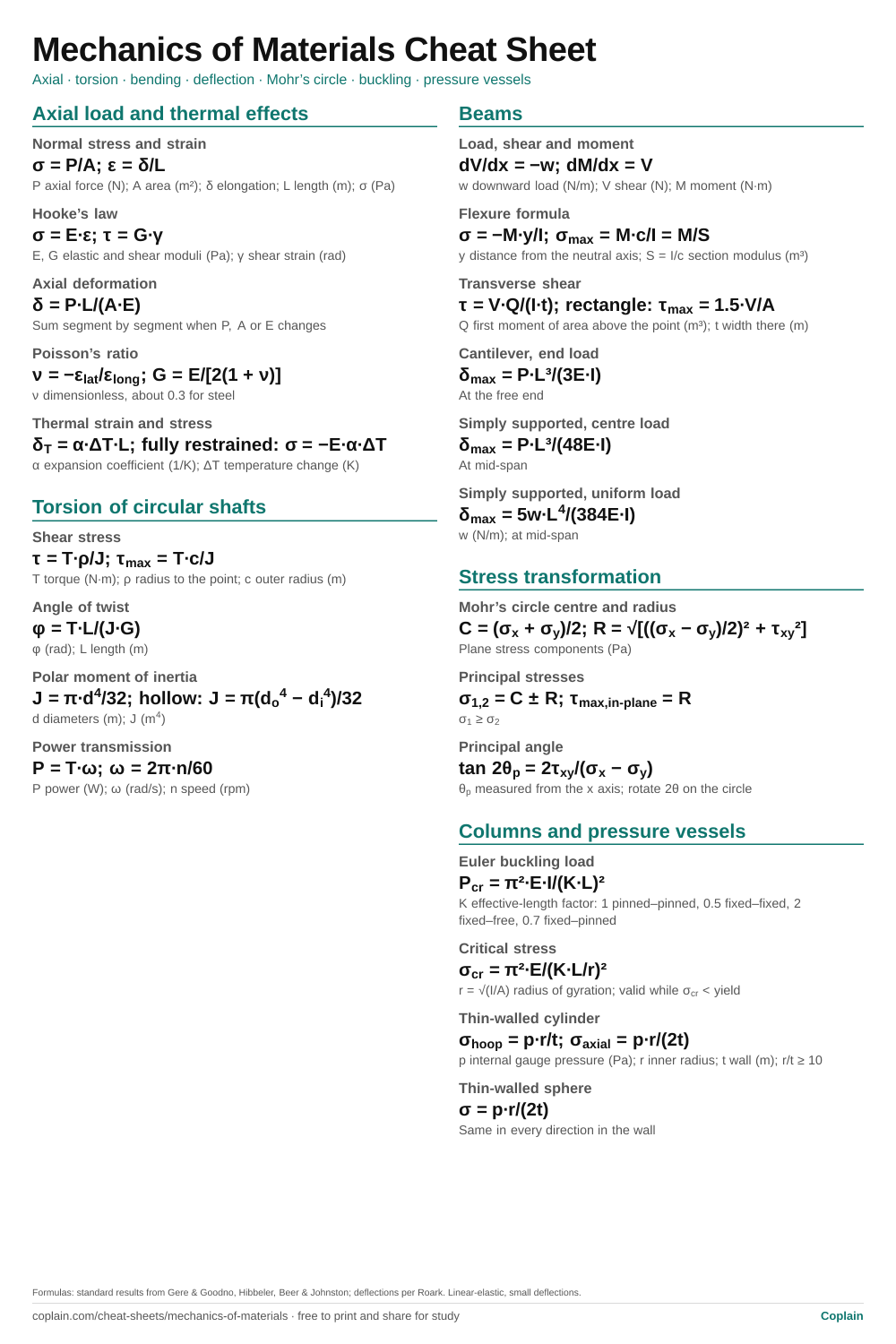
The PDF is one US Letter page that also prints on A4 without cropping. The 2:3 PNG is the same sheet as an image, sized for a phone lock screen or a pin. Both are made from the formulas in the tables above, so they always match.

Mechanics of Materials Cheat Sheet: Axial · torsion · bending · deflection · Mohr’s circle · buckling · pressure vessels
Mechanics of Materials Cheat Sheet (PNG, 2:3)

Matching lessons and calculators

Learn where each formula comes from, then check your own numbers.

All engineering cheat sheets

Frequently asked questions

What is the difference between mechanics of materials and strength of materials?

They are two names for the same course. Both cover stress, strain and deformation in loaded members.

Why is the flexure formula negative?

With y measured upward from the neutral axis and a positive (sagging) moment, the top fibres are in compression. The minus sign makes compression negative. Many students use the magnitude M·c/I and decide tension or compression by inspection.

When is a pressure vessel thin-walled?

The usual rule is a radius-to-thickness ratio of 10 or more. Below that, the stress varies noticeably through the wall and thick-wall (Lamé) equations are needed.
See also

More cheat sheets

Sources

  1. J. M. Gere, B. J. Goodno, Mechanics of Materials, Cengage
  2. R. C. Hibbeler, Mechanics of Materials, Pearson
  3. F. P. Beer, E. R. Johnston, J. T. DeWolf, D. F. Mazurek, Mechanics of Materials, McGraw Hill
  4. W. C. Young, R. G. Budynas, A. M. Sadegh, Roark’s Formulas for Stress and Strain, McGraw Hill

Last updated

COPLAIN AI PLATFORM

Generate yours automatically from your existing docs

Heading into manufacturing? Coplain turns engineering procedures into clear, audit-ready work instructions and job aids for the shop floor.

Generate yours automatically with Coplain →