AWG Wire Gauge Chart
American Wire Gauge (AWG) sizes follow one formula: diameter = 0.005 in × 92^((36 − AWG) ÷ 39). 12 AWG is 0.0808 in (2.05 mm) with 3.31 mm² of copper; 10 AWG is 0.1019 in (2.59 mm), 5.26 mm², and about 0.999 Ω per 1000 ft of solid copper at 20 °C.
AWG sizes, area and resistance
Showing 44 of 44 rows
| AWG | Diameter (in) | Diameter (mm) | Area (kcmil) | Area (mm²) | Ω per 1000 ft | Ω per km |
|---|---|---|---|---|---|---|
| 0000 (4/0) | 0.4600 | 11.684 | 211.6 | 107.2 | 0.04901 | 0.1608 |
| 000 (3/0) | 0.4096 | 10.405 | 167.8 | 85.03 | 0.06180 | 0.2028 |
| 00 (2/0) | 0.3648 | 9.266 | 133.1 | 67.43 | 0.07793 | 0.2557 |
| 0 (1/0) | 0.3249 | 8.251 | 105.5 | 53.48 | 0.09827 | 0.3224 |
| 1 | 0.2893 | 7.348 | 83.69 | 42.41 | 0.1239 | 0.4066 |
| 2 | 0.2576 | 6.544 | 66.37 | 33.63 | 0.1563 | 0.5127 |
| 3 | 0.2294 | 5.827 | 52.63 | 26.67 | 0.1970 | 0.6464 |
| 4 | 0.2043 | 5.189 | 41.74 | 21.15 | 0.2485 | 0.8152 |
| 5 | 0.1819 | 4.621 | 33.10 | 16.77 | 0.3133 | 1.028 |
| 6 | 0.1620 | 4.115 | 26.25 | 13.30 | 0.3951 | 1.296 |
| 7 | 0.1443 | 3.665 | 20.82 | 10.55 | 0.4982 | 1.634 |
| 8 | 0.1285 | 3.264 | 16.51 | 8.366 | 0.6282 | 2.061 |
| 9 | 0.1144 | 2.906 | 13.09 | 6.634 | 0.7921 | 2.599 |
| 10 | 0.1019 | 2.588 | 10.38 | 5.261 | 0.9988 | 3.277 |
| 11 | 0.0907 | 2.305 | 8.234 | 4.172 | 1.260 | 4.132 |
| 12 | 0.0808 | 2.053 | 6.530 | 3.309 | 1.588 | 5.211 |
| 13 | 0.0720 | 1.828 | 5.178 | 2.624 | 2.003 | 6.571 |
| 14 | 0.0641 | 1.628 | 4.107 | 2.081 | 2.525 | 8.285 |
| 15 | 0.0571 | 1.450 | 3.257 | 1.650 | 3.184 | 10.45 |
| 16 | 0.0508 | 1.291 | 2.583 | 1.309 | 4.015 | 13.17 |
| 17 | 0.0453 | 1.150 | 2.048 | 1.038 | 5.063 | 16.61 |
| 18 | 0.0403 | 1.024 | 1.624 | 0.8230 | 6.385 | 20.95 |
| 19 | 0.0359 | 0.912 | 1.288 | 0.6527 | 8.051 | 26.41 |
| 20 | 0.0320 | 0.812 | 1.022 | 0.5176 | 10.15 | 33.31 |
| 21 | 0.0285 | 0.723 | 0.8101 | 0.4105 | 12.80 | 42.00 |
| 22 | 0.0253 | 0.644 | 0.6424 | 0.3255 | 16.14 | 52.96 |
| 23 | 0.0226 | 0.573 | 0.5095 | 0.2582 | 20.36 | 66.78 |
| 24 | 0.0201 | 0.511 | 0.4040 | 0.2047 | 25.67 | 84.21 |
| 25 | 0.0179 | 0.455 | 0.3204 | 0.1624 | 32.37 | 106.2 |
| 26 | 0.0159 | 0.405 | 0.2541 | 0.1288 | 40.81 | 133.9 |
| 27 | 0.0142 | 0.361 | 0.2015 | 0.1021 | 51.47 | 168.9 |
| 28 | 0.0126 | 0.321 | 0.1598 | 0.08098 | 64.90 | 212.9 |
| 29 | 0.0113 | 0.286 | 0.1267 | 0.06422 | 81.83 | 268.5 |
| 30 | 0.0100 | 0.255 | 0.1005 | 0.05093 | 103.2 | 338.5 |
| 31 | 0.0089 | 0.227 | 0.07970 | 0.04039 | 130.1 | 426.9 |
| 32 | 0.0080 | 0.202 | 0.06321 | 0.03203 | 164.1 | 538.3 |
| 33 | 0.0071 | 0.180 | 0.05013 | 0.02540 | 206.9 | 678.8 |
| 34 | 0.0063 | 0.160 | 0.03975 | 0.02014 | 260.9 | 856.0 |
| 35 | 0.0056 | 0.143 | 0.03152 | 0.01597 | 329.0 | 1079 |
| 36 | 0.0050 | 0.127 | 0.02500 | 0.01267 | 414.8 | 1361 |
| 37 | 0.0045 | 0.113 | 0.01983 | 0.01005 | 523.1 | 1716 |
| 38 | 0.0040 | 0.101 | 0.01572 | 0.007967 | 659.6 | 2164 |
| 39 | 0.0035 | 0.090 | 0.01247 | 0.006318 | 831.8 | 2729 |
| 40 | 0.0031 | 0.080 | 0.009888 | 0.005010 | 1049 | 3441 |
How to read the chart
Each row is one gauge. A smaller number is a thicker wire; past 0 the sizes are written 00, 000 and 0000 (2/0, 3/0, 4/0). Every three gauges the area roughly halves and the resistance roughly doubles.
Diameter and area are for one solid round conductor. Stranded wire of the same gauge has about the same copper area but a larger overall diameter.
Resistance is for solid annealed copper at 20 °C. Hot conductors have more resistance: copper gains about 0.4% per °C.
This chart does not list ampacity. Allowable current depends on insulation temperature rating, ambient temperature, bundling and the electrical code that applies, so take it from the code itself, such as NFPA 70, the National Electrical Code, in the United States (linked under Sources below).
How the values are computed
AWG is defined by two fixed points: 0000 is 0.4600 in and 36 is 0.0050 in, with 39 equal ratio steps between them. So d = 0.005 × 92^((36 − n) ÷ 39) inches, where 0, 00, 000 and 0000 are n = 0, −1, −2 and −3. ASTM B258 tabulates the same sizes.
Area in circular mils is the diameter in thousandths of an inch, squared (kcmil = cmil ÷ 1000). Area in mm² is π/4 × d² with d in mm.
Resistance is resistivity ÷ area. The chart uses the International Annealed Copper Standard: 1.7241 µΩ·cm (1/58 Ω·mm²/m) at 20 °C. Aluminum conductors have about 1.6 times the resistance of copper of the same size.
Example: 10 AWG copper
- d = 0.005 × 92^((36 − 10) ÷ 39) = 0.005 × 92^0.6667 = 0.1019 in = 2.588 mm.
- Area = (101.9 mil)² = 10383 cmil = 10.38 kcmil; π/4 × 2.588² = 5.261 mm².
- R = 0.017241 Ω·mm²/m ÷ 5.261 mm² = 0.003277 Ω/m = 3.277 Ω/km.
- Per 1000 ft: 3.277 × 0.3048 = 0.9988 Ω.
Result: 10 AWG solid copper is 2.59 mm across, 5.26 mm², and 0.999 Ω per 1000 ft at 20 °C.
Common mistakes
- Reading ampacity from a wire size chart. Current rating depends on insulation, temperature and installation. Use the table in the electrical code that applies to the job.
- Measuring stranded wire with calipers to find its gauge. Strands leave air gaps, so the bundle measures larger than the solid diameter. Count and measure one strand, or read the jacket print.
- Converting AWG to mm² by diameter alone. Metric wire is sold by area (mm²). Match the area: 12 AWG (3.31 mm²) sits between 2.5 and 4 mm² metric sizes.
- Using 20 °C resistance for a hot run. Correct for temperature: R rises about 0.4% per °C for copper, and electrical codes tabulate resistance at 75 °C.
- Applying copper values to aluminum wire. Aluminum has about 1.6 times the resistivity of copper; go up two gauges for similar resistance.
Printable chart
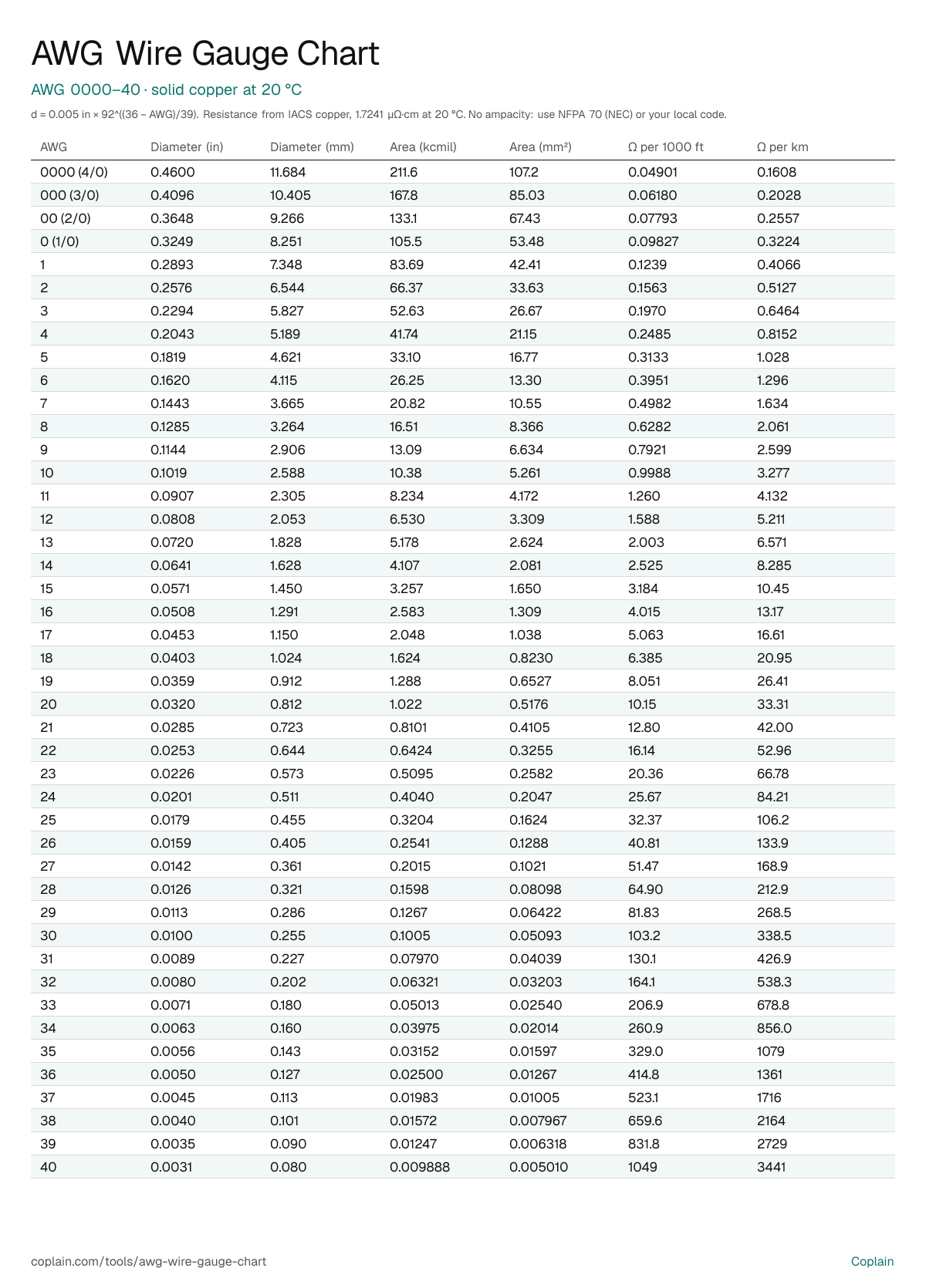
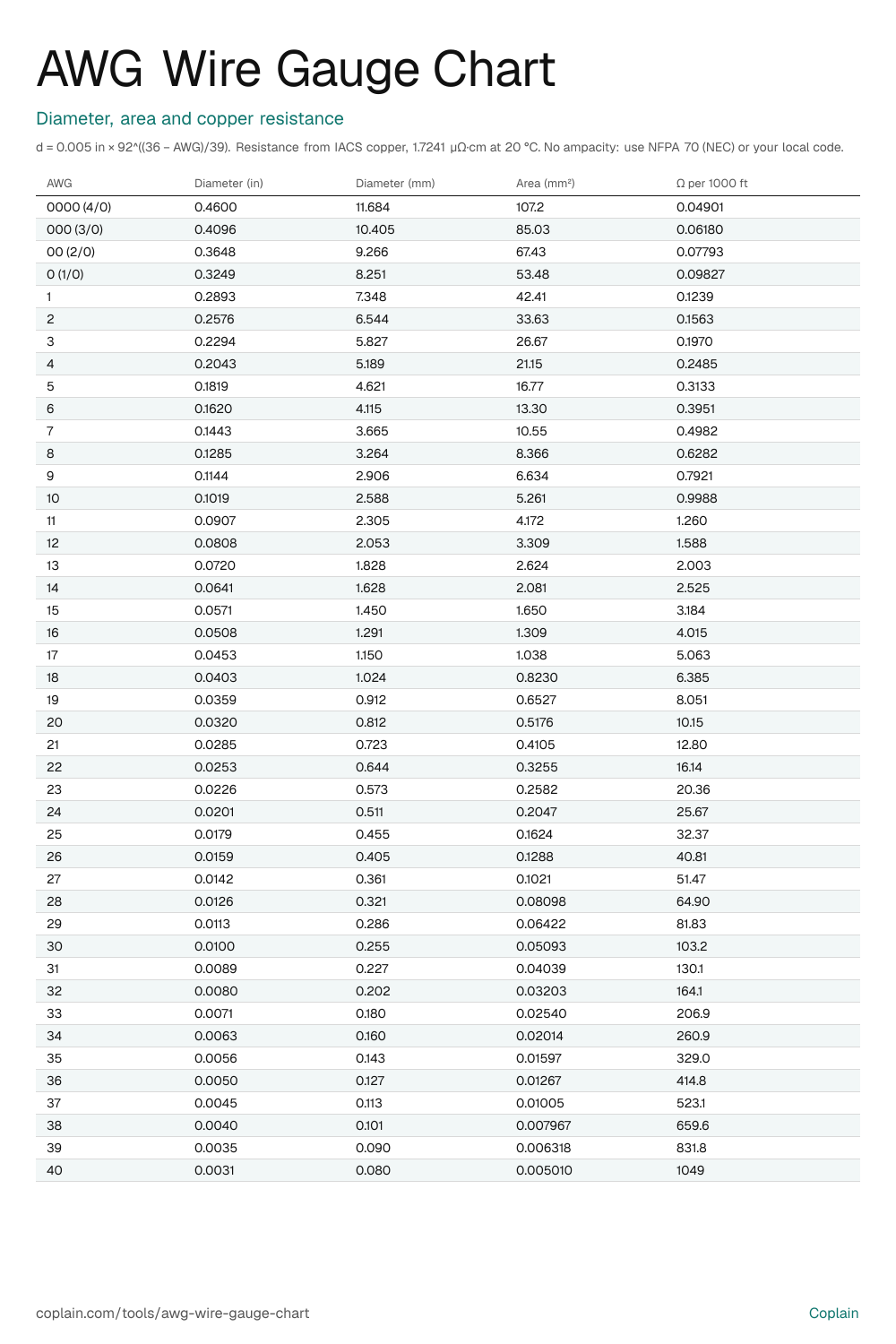
The PDF prints on US Letter or A4. The images are made from the same values as the table above: a full chart, and a 2:3 portrait version for pinning.
Frequently asked questions
What is 12 AWG in mm?
12 AWG is 0.0808 in, or 2.053 mm in diameter, with a cross-section of 3.31 mm².
How many amps can 12 AWG carry?
It depends on insulation rating, ambient temperature, bundling and the code that applies. This chart does not give ampacity; use the ampacity tables in NFPA 70 (NEC) or your local electrical code.
Why does a smaller AWG number mean a bigger wire?
The numbers once counted drawing passes through a die. More passes made a thinner wire, so higher numbers are thinner.
What does 4/0 mean?
4/0 is the same as 0000 AWG, the largest gauge in the series: 0.4600 in (11.68 mm). Larger conductors are sized in kcmil.
Is AWG the same as SWG?
No. SWG (British Standard Wire Gauge) is a different series. 12 SWG is 2.64 mm, while 12 AWG is 2.05 mm.
See also
More reference charts
Sources
- ASTM B258, Standard Specification for Standard Nominal Diameters and Cross-Sectional Areas of AWG Sizes of Solid Round Wires Used as Electrical Conductors, ASTM International
- IEC 60028, International standard of resistance for copper (IACS, 1/58 Ω·mm²/m at 20 °C), IEC
- NFPA 70, National Electrical Code (ampacity tables), NFPA
COPLAIN AI PLATFORM
Generate yours automatically from your existing docs
Coplain turns wiring specs and harness drawings into step-by-step job aids, with wire sizes, colors and checks your assemblers can follow.
Generate yours automatically with Coplain →Related Tools & Templates